What to draw / How to draw / Nature
How to draw a landscape
Mountain valley with a river and a big tree: 9 steps, about 30 minutes. Red lines are new in each step; grey lines are what you've already drawn.
Step 1 of 9
Draw a rectangle for the frame. Mark a light horizon line just above the middle, a light oval on the left for the crown of a big tree in the foreground, and a winding guide for a river from the horizon down to the bottom edge.
· · Steps as a list
How to draw a landscape (detailed), step by step
-

1 Step 1
Draw a rectangle for the frame. Mark a light horizon line just above the middle, a light oval on the left for the crown of a big tree in the foreground, and a winding guide for a river from the horizon down to the bottom edge.
-
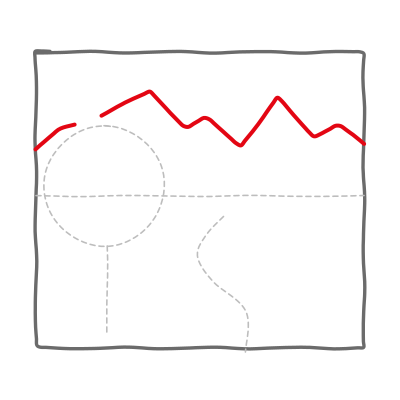
2 Step 2
Background: draw the mountain ridge as one zig-zag line across the frame, with two tall peaks and a lower one between them. Stop the line where it reaches the tree guide; the tree will hide that part.
-
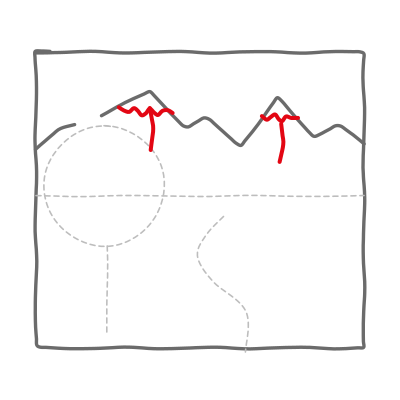
3 Step 3
Add a jagged snow line just under the two tall peaks, and a few lines running down from the peaks to show the ridges on the mountain faces.
-
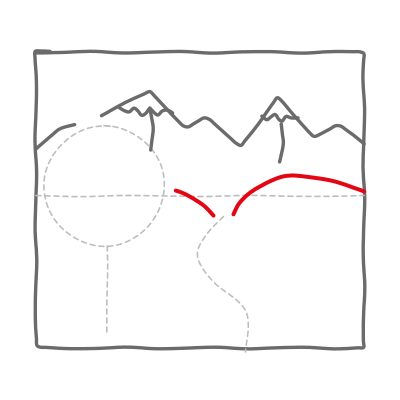
4 Step 4
Middle ground: draw two rolling hills in front of the mountains, sitting on the horizon. The left one slopes down to the right and the right one slopes down to the left, leaving a narrow gap between them in the middle.
-
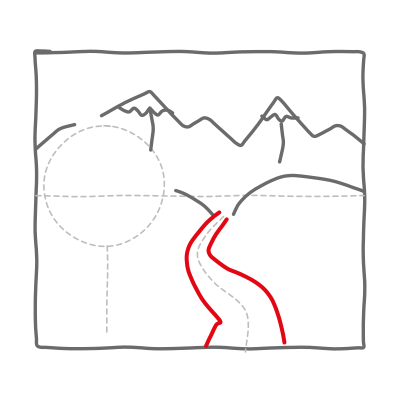
5 Step 5
Draw the river along its guide. It starts as a thin ribbon in the gap between the hills and widens as it winds toward you, bending one way and then the other, until it is wide where it leaves the bottom of the frame.
-
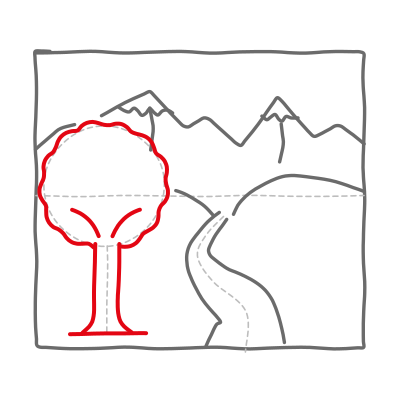
6 Step 6
Foreground: draw the big tree over its guide. A bumpy, scalloped crown, a trunk that widens into roots at the bottom, two branches showing inside the crown, and a short ground line at its base.
-
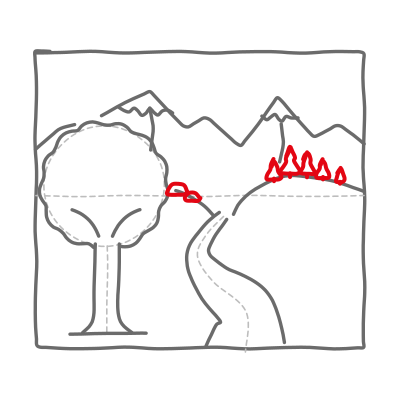
7 Step 7
Add small pointed trees standing along the right hill, in a group that gets smaller toward the right, and two small round bushes on the left hill, all sitting right on the hill line. Being far away, they stay tiny and simple.
-
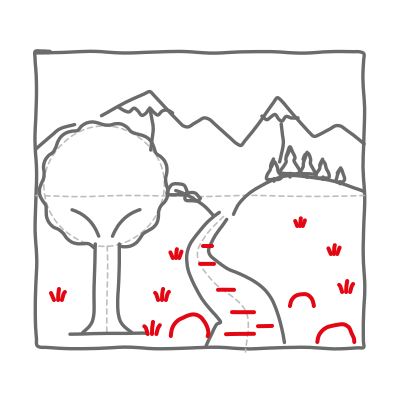
8 Step 8
Add a few rocks along the river banks and in the bottom right corner, small tufts of grass across the near ground, and short horizontal ripple lines on the river, longer near the bottom.
-
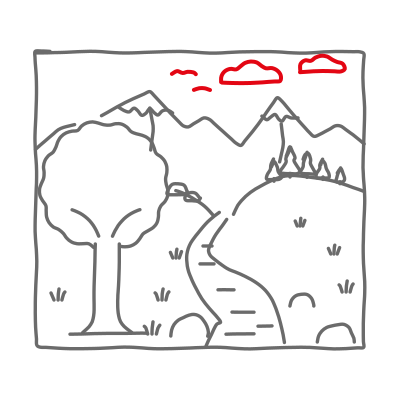
9 Step 9
Erase the guides. Finish the sky with two small flat-bottomed clouds and a couple of birds above the mountains.
-
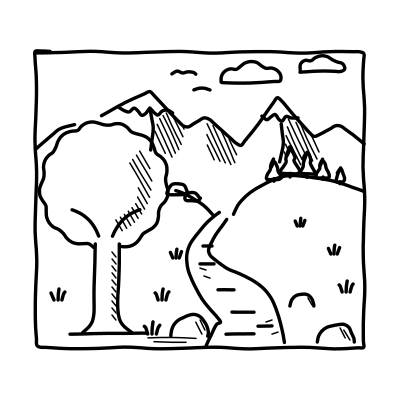
✓ Finished
Ink the lines you want to keep, erase the pencil, and add the shading strokes shown here on the side away from the light.
Step 1 of 5
Draw a light horizon line a little below the middle. Draw a big rounded hill on the left that comes down to just past the middle, and a second, flatter hill on the right that starts where the first one ends, as if it sits behind it.
· · Steps as a list
How to draw a landscape (easy), step by step
-

1 Step 1
Draw a light horizon line a little below the middle. Draw a big rounded hill on the left that comes down to just past the middle, and a second, flatter hill on the right that starts where the first one ends, as if it sits behind it.
-
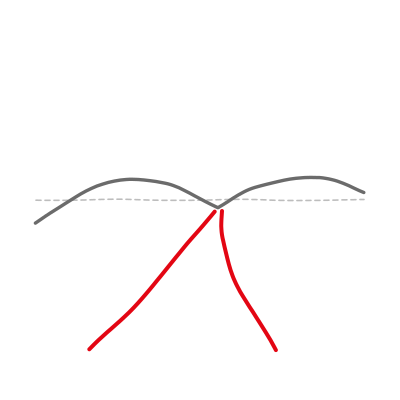
2 Step 2
Draw a path from the dip between the hills down to the bottom of the page: two lines that start close together and spread wide apart, with a gentle bend.
-
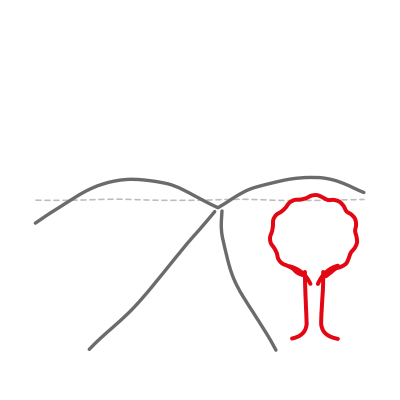
3 Step 3
Draw a tree on the right of the path, in front of the far hill: a bumpy round crown, a straight trunk that flares out at the bottom, and two short branches inside the crown.
-
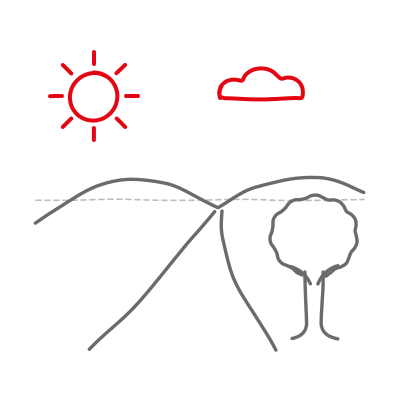
4 Step 4
Add a sun with short rays in the top left and a flat-bottomed cloud on the right.
-
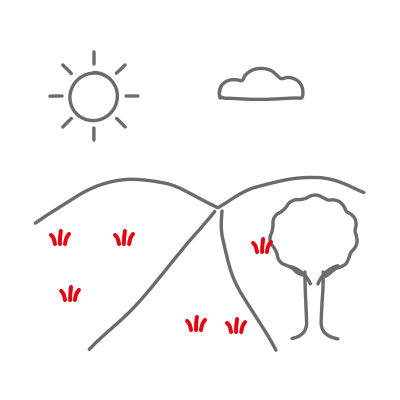
5 Step 5
Erase the guide and add small tufts of grass, bigger near the bottom of the page.
-
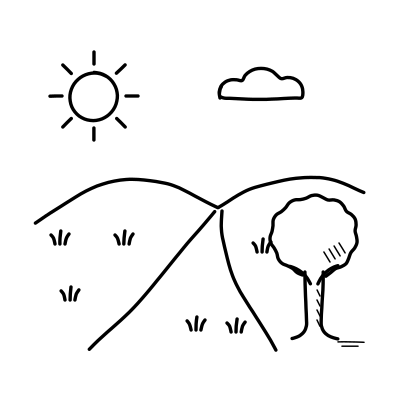
✓ Finished
Ink the lines you want to keep, erase the pencil, and add the shading strokes shown here on the side away from the light.
About this drawing
A landscape looks deep when it is built in three layers: a background (mountains, low on detail), a middle ground (hills and small trees) and a foreground (one big tree, rocks and grass, drawn large and detailed). A river that starts thin at the horizon and gets wide at the bottom of the page ties the layers together and pulls the eye into the picture. The detailed version draws mountains, hills, a winding river and a foreground tree inside a frame; the easy version uses two hills, a path and one tree.
You need: Pencil, eraser, ruler for the frame, paper. A fine pen for inking.
Tips
- Place the horizon off-centre. A horizon a little above the middle gives room for the river and foreground; below the middle gives a big sky.
- Build it in three planes: background, middle ground, foreground. Each plane overlaps the one behind it, and overlap is the strongest depth cue you have.
- Things get smaller, simpler and lighter with distance. The near tree gets bark, branches and shading; the distant trees are tiny triangles; the mountains are a single line with a little hatching.
- Make a river or path narrow at the horizon and wide at the bottom, and let it wind. The bends shrink as they go back, just like the river itself.
- Draw the foreground object first in your mind: mark its guide, then stop the background lines where they meet it instead of erasing them later.
Common mistakes
- River the same width all the way. It reads as a stripe pasted on a hill. Narrow it to a thread at the horizon and widen it toward you.
- Everything the same size and detail. Without a large foreground object and tiny distant ones, the picture looks flat. Put one big thing close to you.
- Mountains drawn as a row of identical triangles. Vary the heights and spacing, let peaks overlap, and keep the slopes slightly uneven.
- Shading on random sides. Pick one light direction (here, upper left) and hatch the right-hand faces of the mountains and the lower right of the tree.
Once you can draw it: 6 ideas to try
- The same valley in winter: bare tree, snow on the hills, the river frozen at the edges
- A coastal landscape: cliffs on one side, a beach and the sea where the river would be
- A wheat field with a dirt road running to a farmhouse on the horizon
- A desert landscape with mesas in the background and a cactus in the foreground
- A lake reflecting the mountains, with a small wooden pier in the foreground
- The view from a window: the frame of the window becomes your foreground
Want something random? Roll a drawing idea.
Questions
How do you draw a landscape easy?
Draw a horizon line, then two overlapping hills on it. Add a path that starts as a point between the hills and gets wider toward the bottom of the page, one tree in the foreground on one side, and a sun or a cloud in the sky.
How do you draw a landscape with depth?
Use three planes: mountains in the background, hills and small trees in the middle ground, and one large, detailed object in the foreground. Overlap them, make distant things smaller and simpler, and run a river or path from the horizon toward you, narrow at the back and wide at the front.
How do you draw a realistic landscape with a pencil?
Keep the background light and loose and press harder as you come forward. Hatch the shadow sides of the mountains and the tree with one light direction in mind, and put the darkest marks and most texture in the foreground.
How do I draw mountains in a landscape?
Draw the ridge as one zig-zag line with peaks of different heights. Add a jagged snow line under the tallest peaks, a few lines running down from each summit for the ridges, and hatch the side facing away from the light.