What to draw / How to draw / Animals
How to draw a wolf
Standing grey wolf, side view, with neck ruff: 10 steps, about 25 minutes. Red lines are new in each step; grey lines are what you've already drawn.
Step 1 of 10
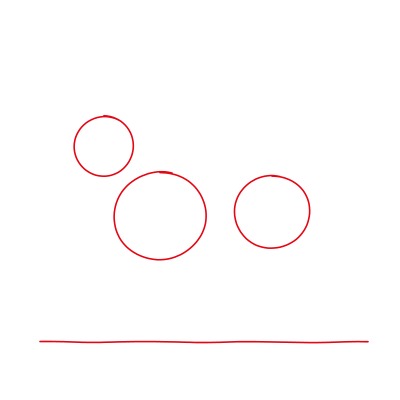
Lightly draw three circles: one for the head at upper left, a large one for the chest, and a slightly smaller one for the hips. Leave about one head-width between chest and hips. Add a ground line.
· · Steps as a list
How to draw a wolf (detailed), step by step
-
1 Step 1
Lightly draw three circles: one for the head at upper left, a large one for the chest, and a slightly smaller one for the hips. Leave about one head-width between chest and hips. Add a ground line.
-
2 Step 2
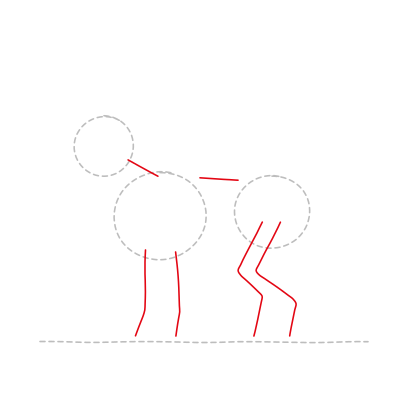
Draw a stick skeleton for the legs. The front legs drop almost straight down from the chest, with a small bend at the wrist. The back legs bend like a Z: knee forward, hock pointing back, then a near-vertical line to the paw. Join the circles with a line for the neck and back.
-
3 Step 3
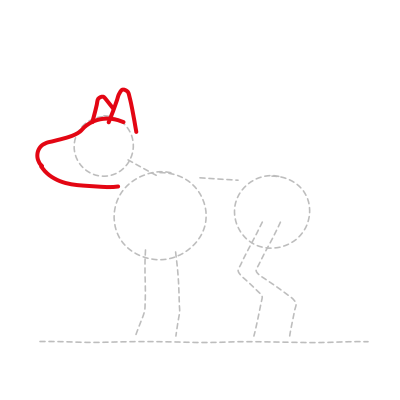
Draw the head. A gently sloping forehead steps down at the eye to a long, deep muzzle that ends in a blunt nose. Bring the lower jaw back underneath, and put two short, thick ears with rounded tips at the back of the skull.
-
4 Step 4
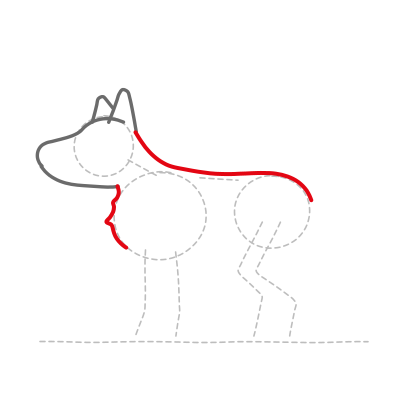
Draw the thick neck: the top line runs from behind the ears down to the shoulders, and the throat swells forward into a shaggy ruff over the chest. Continue the back almost level to the hips and round it over the rump.
-
5 Step 5
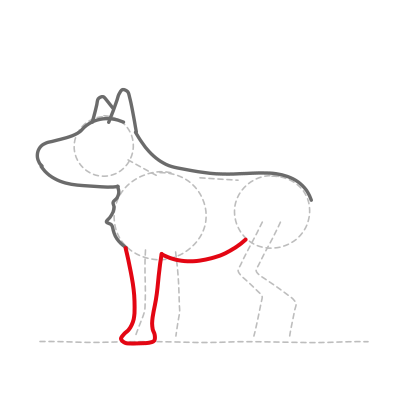
Draw the near front leg as a straight column from the chest down to the wrist, then a short, slightly sloped pastern and an oval paw. Carry the belly line back from the elbow, rising to a tucked-up waist.
-
6 Step 6
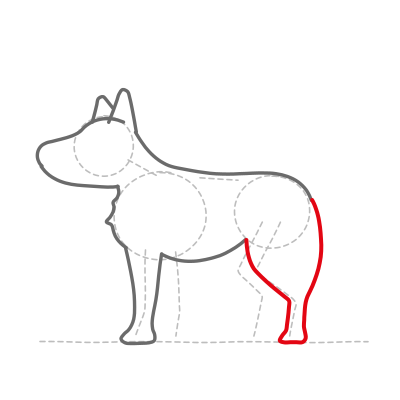
Draw the near hind leg around the Z: the front of the thigh bulges out to the knee, the lower leg angles back to a sharp hock, and the long foot drops almost straight to the paw. The back of the thigh is one big curve down from the rump.
-
7 Step 7
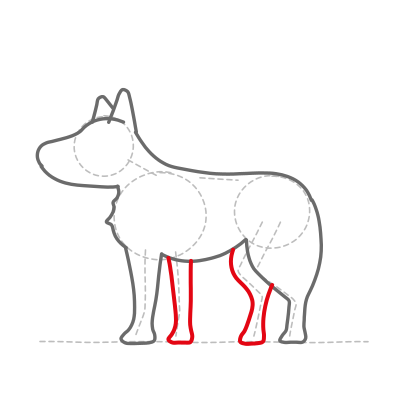
Add the far legs, which are partly hidden. The far front leg shows behind the near one, a little further back; the far hind leg steps forward under the belly. Draw only the parts you can see.
-
8 Step 8
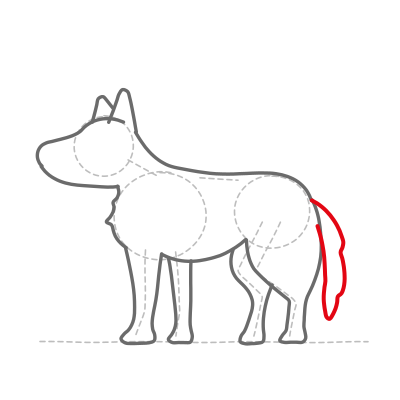
Draw the bushy tail hanging from the rump, thick in the middle and narrowing to a point near the hocks. Break the outer edge with a couple of small notches for the fur, and keep a gap between the tail and the thigh.
-
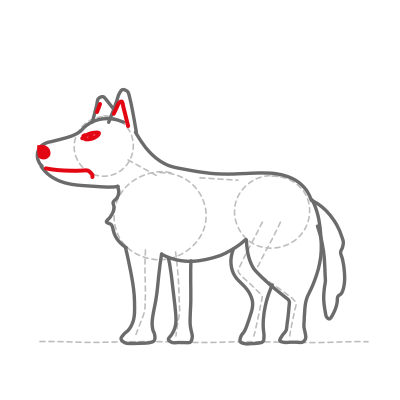
9 Step 9
Add the face: an almond eye slanting up towards the ear, the nose pad at the tip of the muzzle, and the mouth line running back under the cheek. Mark the inside of each ear with a short line.
-
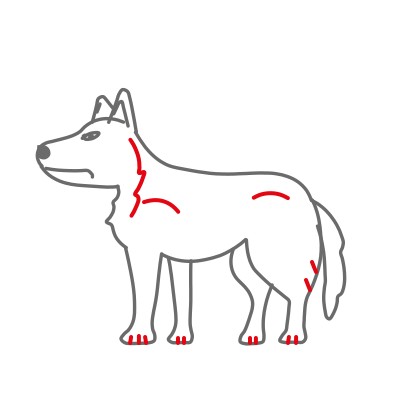
10 Step 10
Erase the guides. Add the cheek ruff behind the jaw, break the ruff into fur tufts, add a curve for the shoulder and the hip, and draw the toes on each paw.
-
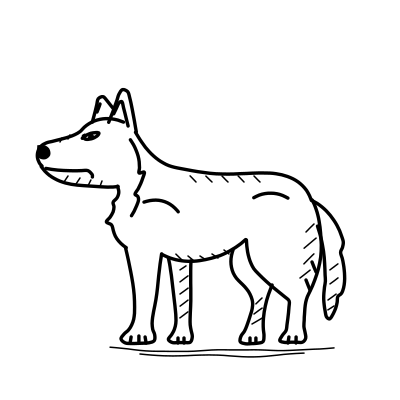
✓ Finished
Ink the lines you want to keep, erase the pencil, and add the shading strokes shown here on the side away from the light.
Step 1 of 6
Lightly draw a circle for the head near the top left, a tall oval for the chest under it, and a big circle for the haunch at the bottom right. Add a ground line.
· · Steps as a list
How to draw a wolf (easy), step by step
-
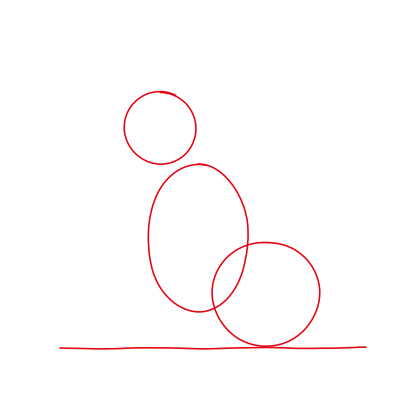
1 Step 1
Lightly draw a circle for the head near the top left, a tall oval for the chest under it, and a big circle for the haunch at the bottom right. Add a ground line.
-
2 Step 2
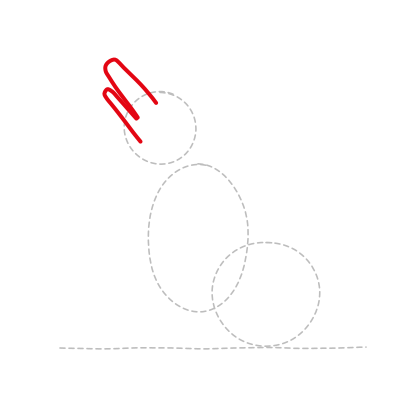
Point the muzzle up and to the left for the howl: a long, thick box coming off the head and ending in a blunt nose. Draw the lower jaw just under it, slightly open, so the mouth makes a narrow V.
-
3 Step 3
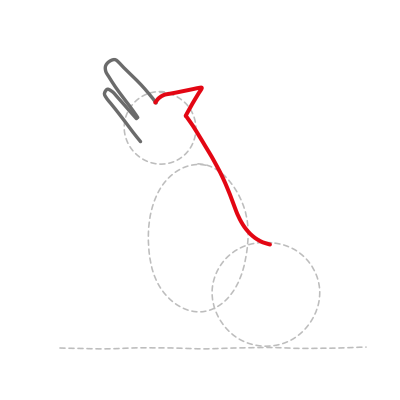
Lay the ears flat back along the top of the head, then draw the back of the head and neck flowing down and out into the back.
-
4 Step 4
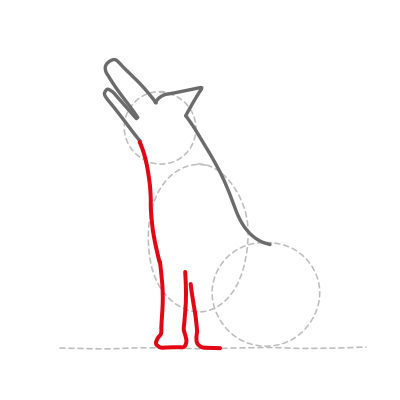
Draw the throat and the shaggy chest curving down from the jaw. Drop two straight front legs to the ground, ending in rounded paws, the far one tucked just behind the near one.
-
5 Step 5
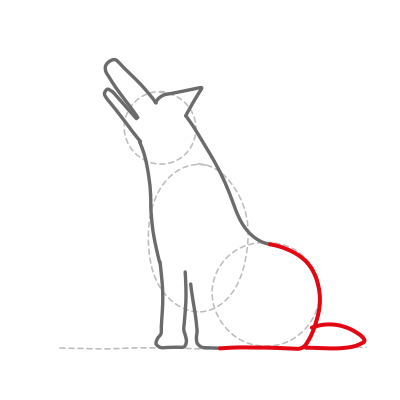
Draw the big round haunch and the long hind foot lying flat in front of it, then sweep a bushy tail out from under the haunch along the ground.
-
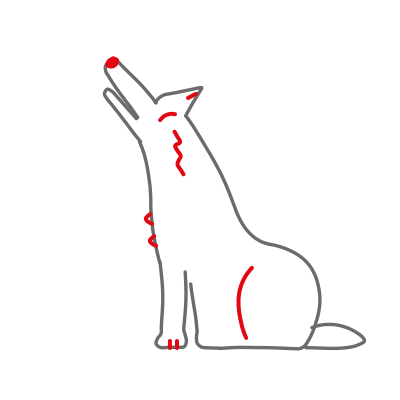
6 Step 6
Erase the guides. Add the closed eye as a short slanted curve, the nose pad, the ruff of fur behind the cheek, the line of the thigh and the toes.
-
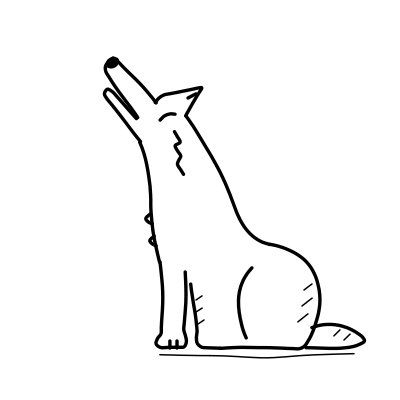
✓ Finished
Ink the lines you want to keep, erase the pencil, and add the shading strokes shown here on the side away from the light.
About this drawing
A wolf looks like a big dog until you get three things right: long legs that lift the body high off the ground, a deep narrow chest with a thick ruff of fur around the neck, and a tail that hangs straight down instead of curling up. This drawing builds a standing wolf side-on from three circles and a stick-figure skeleton for the legs, so the joints land in the right place before any fur goes on.
You need: Pencil, eraser, paper. A fine pen for inking and a softer pencil for the shading.
Tips
- Make the legs long. A wolf's chest sits about halfway between the top of its back and the ground; if the belly hangs lower than that, it turns into a husky.
- Use the three circles (head, chest, hips) to set the proportions: the gap between the chest and hip circles is about one head-width, which keeps the body lean.
- The back legs bend like a Z: knee forward, hock (the heel) pointing backwards, then a near-vertical lower leg to the paw. Draw the stick skeleton first.
- Keep the tail hanging down and slightly away from the hind legs. A relaxed wolf carries it low; only a dominant or excited wolf raises it.
- Draw fur with short flicks along the edge of the ruff, cheeks and tail, not all over the body. A smooth outline with a few tufts reads as fur better than scribbling.
Common mistakes
- Head too round, muzzle too short. That reads as a puppy or a fox. The muzzle is roughly as long as the skull, with a gentle step (the stop) at the eyes.
- Back legs bent forward at the bottom. The hock always points back. Check that the joint above the paw sits behind the paw, not in front of it.
- Ears floppy or too big. Wolf ears are short, thick triangles with rounded tips, standing up and set towards the back of the skull.
- A belly that sags. Wolves are lean: the underline rises from the deep chest to a tucked-up waist in front of the hind legs.
Once you can draw it: 6 ideas to try
- A wolf howling, sitting on a snowy ridge, muzzle pointed straight up
- A wolf mid-trot, diagonal legs moving together, head held low
- A head-and-shoulders wolf portrait in three-quarter view, eyes towards you
- Two wolf pups play-fighting, all oversized paws and ears
- A wolf lying down with its chin on its front paws, tail curled round
- An arctic wolf in a blizzard, drawn with very few lines and lots of white
Want something random? Roll a drawing idea.
Questions
How do you draw a wolf easy?
Start with a sitting wolf: a circle for the head, a tall oval for the chest and a round haunch at the back. Point the muzzle up for a howl, lay the ears back, drop two straight front legs from the chest and lay a bushy tail along the ground. The Easy version above does exactly this in six steps.
How do I draw a realistic wolf?
Get the proportions right before any fur: long legs (the chest is halfway up), a deep narrow chest, a lean tucked-up waist and a muzzle as long as the skull. Then draw the fur as tufts only along the ruff, cheeks, thighs and tail, and shade the far legs, belly and the back of the thighs darker.
How do I draw a wolf's head from the side?
Draw a circle for the skull and a long box for the muzzle coming off its lower front. Step the forehead down at the eye, make the nose a blunt end with a rounded pad, slant the almond eye up towards the ear, and put the short triangle ears at the back of the circle.
What is the difference between drawing a wolf and a dog?
A wolf has longer legs, bigger paws, a narrower chest, a thick ruff around the neck and a straight, low-hanging tail. Its ears are short and its eyes small and slanted. Most dogs have rounder skulls, shorter muzzles and tails carried higher.