What to draw / How to draw / Objects
How to draw an airplane
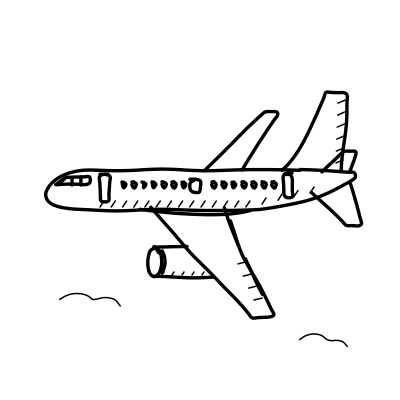
Passenger jet in flight, seen from the side: 8 steps, about 25 minutes. Red lines are new in each step; grey lines are what you've already drawn.
Step 1 of 8
Draw a long horizontal centre line for the body (fuselage), then two parallel guide lines above and below it. The body is a long tube about eight times as long as it is tall.
· · Steps as a list
How to draw an airplane (detailed), step by step
-
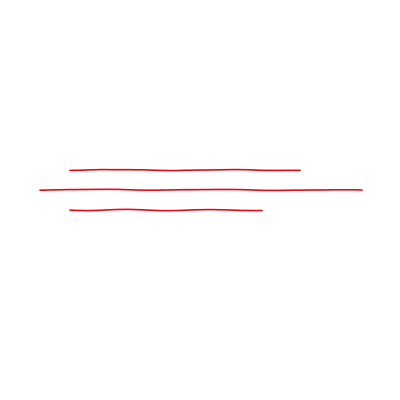
1 Step 1
Draw a long horizontal centre line for the body (fuselage), then two parallel guide lines above and below it. The body is a long tube about eight times as long as it is tall.
-
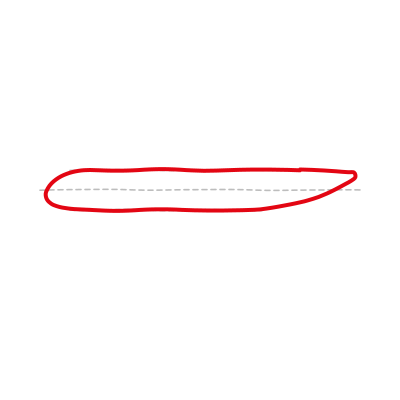
2 Step 2
Draw the fuselage over the guides. Round the nose off with a blunt, slightly drooping curve. At the back, keep the top line straight and sweep the bottom line up to a narrow tail cone.
-
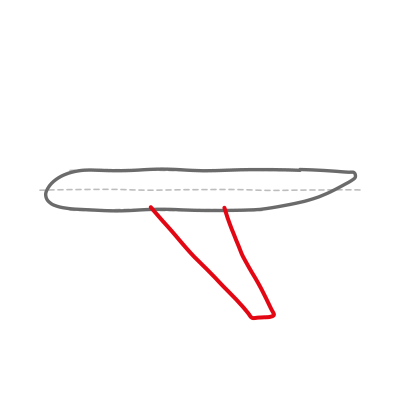
3 Step 3
Draw the near wing. It starts under the middle of the body and sweeps back and down towards you: a long leading edge, a short square tip, and a trailing edge that bends once near the body.
-
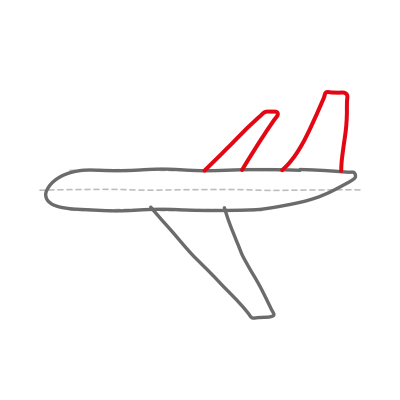
4 Step 4
Add the far wing: only its back half shows, rising above the body because it points away from you. Make it shorter than the near wing. Then draw the tall tail fin, swept back, with a flat top.
-
5 Step 5
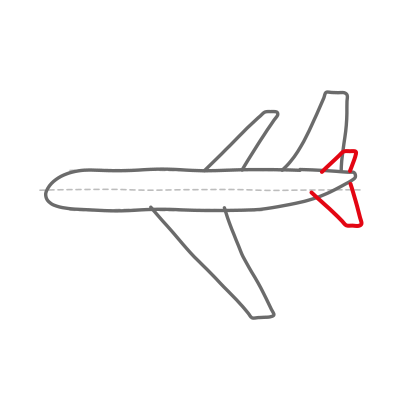
Draw the two small tail wings (horizontal stabilisers). The near one hangs below the tail cone and sweeps back like the main wing; the far one peeks out above the body in front of the fin.
-
6 Step 6
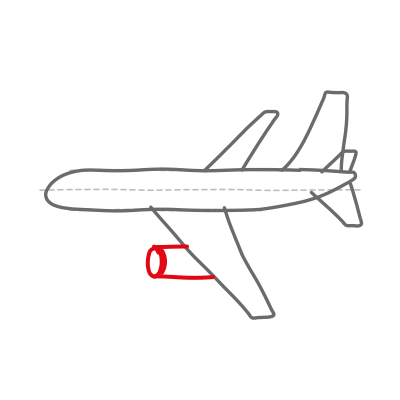
Hang the engine under the near wing, about a third of the way out. Only its front half shows: a short tube that starts with an oval air intake well ahead of the wing and disappears behind the leading edge. Add a curve inside the intake for the fan.
-
7 Step 7
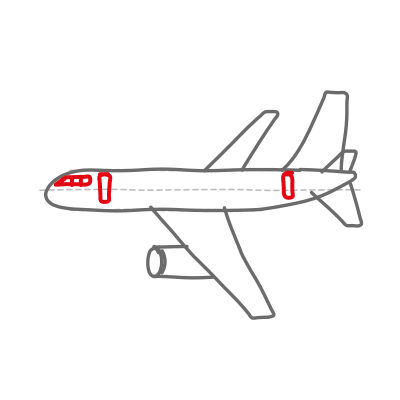
Draw the cockpit windows as a narrow slanted band on top of the nose, split into three panes. Add the front and rear doors as tall, thin rectangles.
-
8 Step 8
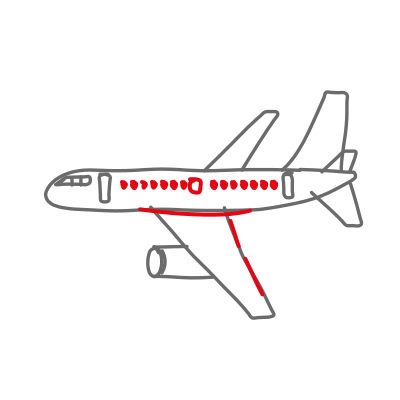
Erase the guides. Add the long row of small passenger windows along the upper third of the body, with an overwing exit in the middle, and a few short lines on the wing for the flaps.
-
✓ Finished
Ink the lines you want to keep, erase the pencil, and add the shading strokes shown here on the side away from the light.
Step 1 of 5
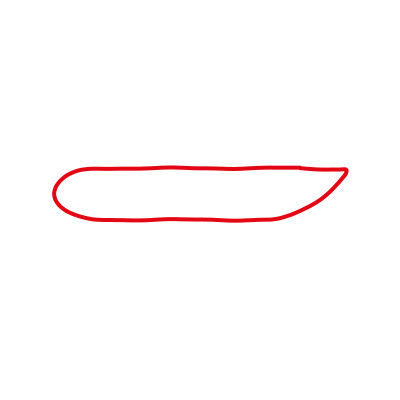
Draw a long, rounded body: a straight top line, a round nose on the left, and a bottom line that curves up to a point at the tail on the right.
· · Steps as a list
How to draw an airplane (easy), step by step
-
1 Step 1
Draw a long, rounded body: a straight top line, a round nose on the left, and a bottom line that curves up to a point at the tail on the right.
-
2 Step 2
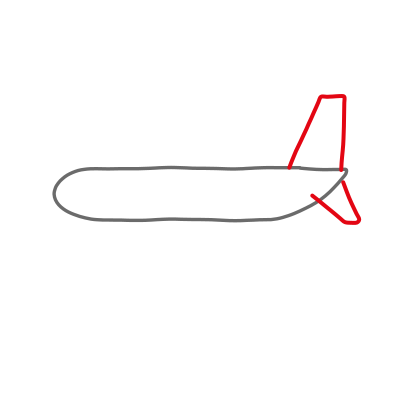
Add the tall tail fin on top of the back end, leaning back, and a small tail wing under it.
-
3 Step 3
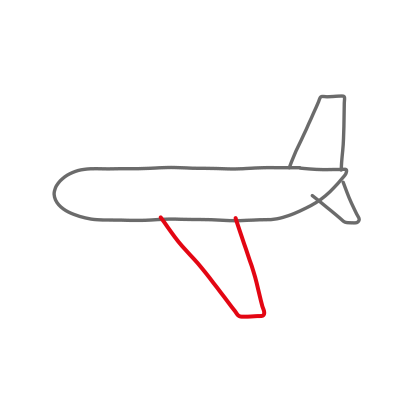
Draw the big wing as a long slanted shape coming out from the middle of the body and sweeping back towards the lower right.
-
4 Step 4
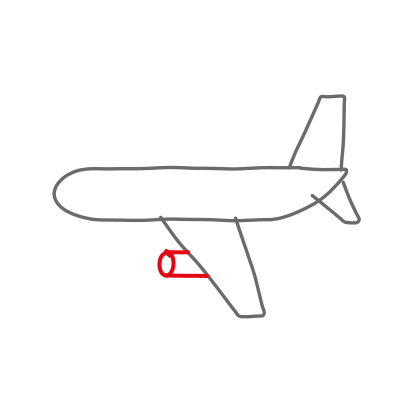
Hang an engine under the wing: a short tube with an oval opening at the front. Stop its lines where they meet the wing, so the engine tucks in behind it.
-
5 Step 5
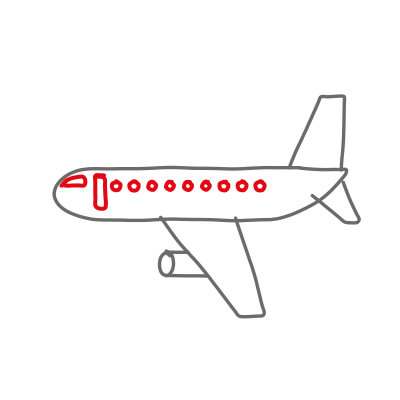
Finish with a curved cockpit window at the nose, a door just behind it, and a row of round windows along the body.
-
✓ Finished
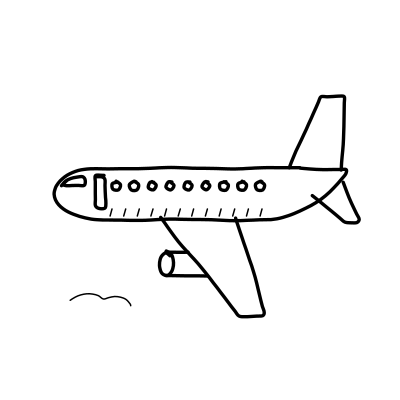
Ink the lines you want to keep, erase the pencil, and add the shading strokes shown here on the side away from the light.
About this drawing
A passenger jet is a long tube with wings, and the whole drawing hangs on two things: the proportions of that tube, and the sweep of the wings. Draw the fuselage first from straight guide lines, then let the near wing sweep back and down towards you while only the tip of the far wing shows above the body. The engines, tail and windows are small parts that go on afterwards. The easy version is a simpler side view with round windows and one wing.
You need: Pencil, eraser, ruler (optional, for the guide lines), paper. A fine pen for inking.
Tips
- Keep the fuselage long: about eight times as long as it is tall. A short body makes any plane look like a toy.
- Sweep both wings back by the same angle. The leading edges of the wings and the tail wings should run roughly parallel.
- The wings attach low on the body, near the belly. The far wing shows above the fuselage only because it points away from you.
- Hang the engine in front of the wing, not behind it. The intake sits well forward of the leading edge on a short pylon.
- Use a ruler for the guide lines only, then ink freehand. Slightly wobbly lines over straight guides look drawn, not technical.
Common mistakes
- Wings sticking straight out sideways. Jet wings are swept back. Start the leading edge under the front half of the body and angle it towards the tail.
- Windows too big. Passenger windows are small and close together, running in one straight line along the upper part of the body.
- Tail drawn as a triangle on the end. The fin rises from the top of the body in front of the tail cone, leans back, and has a flat top.
- Both wings the same length. The far wing is foreshortened and partly hidden; drawing it as long as the near one flattens the plane.
Once you can draw it: 6 ideas to try
- The same jet taking off: nose tilted up, landing gear just folding away
- A plane seen from straight below, an X of wings and tail against the sky
- A small propeller plane with straight wings and a high tail
- A jet leaving long contrails across the sky, drawn small in the corner of a landscape
- A plane parked at a gate, with the stairs and a baggage cart beside it
- A paper airplane gliding across the page, with a dotted flight path
Want something random? Roll a drawing idea.
Questions
How do you draw an airplane easy?
Draw a long rounded body with a pointed tail, a tall fin on top of the back end, and one big wing slanting back from the middle. Hang an oval engine under the wing and add a row of round windows. That is the easy version on this page, and it takes about ten minutes.
How do I draw a realistic airplane?
Start from straight guide lines so the fuselage is long and even, then get the wing sweep right: both wings and the tail wings angle back by about the same amount. Add the details that real jets have: a slanted cockpit window band, doors, a dense row of small windows, flap lines and a wing-to-body fairing.
How do you draw a plane from the side?
Draw the fuselage as a long tube on a horizontal centre line, with the nose rounded at one end and the tail cone sweeping up at the other. In a pure side view you only see the near wing as a thin slanted shape; turning it slightly towards you, as in the detailed drawing, makes the wing much more readable.
How do I draw an airplane in the sky?
Keep the plane small and add a few soft cloud outlines and a contrail behind it. Shade only the underside of the body and wings, because the light comes from above.